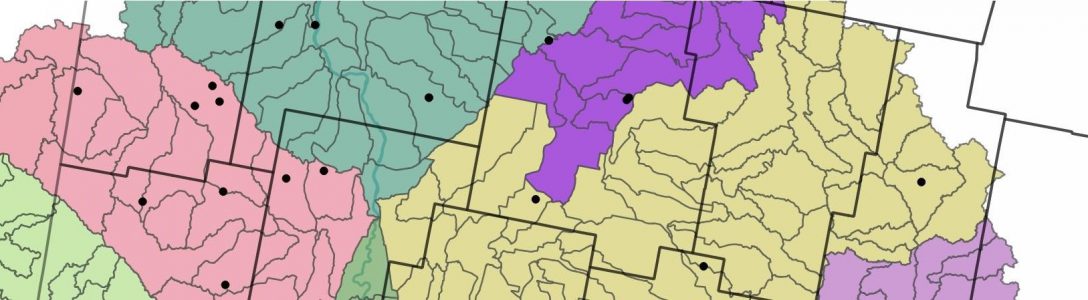
Blog post co-written by Emma Matcham and Lauren Geiss Today's blog post is co-written by Emma Matcham and Lauren Geiss, and shares a protocol they developed for making maps in QGIS. This protocol started as an email Emma sent to a colleague in 2019 with directions for how to make a map for a multistate… Continue reading A Simple Protocol for Map Making for Publications
Tag: GIS
Inverse Distance Weighting and Kriging in R
I posted a few months ago about a new R package I wrote with Filipe Matias-- it's available for download on GitHub. Last week we extended the GitHub tutorial to include interpolation methods and raster visualization/mapping example code. Spatially Challenged readers have asked me to write tutorials on these techniques before, but I had been… Continue reading Inverse Distance Weighting and Kriging in R
EJSCREEN: a tool for visualizing Environmental Justice
This week I learned about a great tool from the US EPA called EJSCREEN, which allows users to visualize and download data related to environmental justice. The US has a long history of environmental racism, including building highways through predominantly black neighborhoods and using former factory sites for low-income housing. Pollution and increased noise exposure… Continue reading EJSCREEN: a tool for visualizing Environmental Justice
SAGA Resources
Here's a secret from bloggers: we get a tally of how many times each page or post gets clicked on our sites. This year I've gotten a lot of readers clicking on my older SAGA articles, so it seems like a good time to share some of my favorite SAGA resources even though it's not… Continue reading SAGA Resources
Paper Size in QGIS 3 Print Layouts
I make most of my maps for publications and presentations in QGIS using the Print Layout feature. This is a wonderfully detailed tutorial if you want to learn more about print layouts. Right now I'm using the print layout to make maps of pH, organic matter, and soil test potassium to include in an update… Continue reading Paper Size in QGIS 3 Print Layouts
Data Downloads: State and County Maps
For a long while the most frequent question I got from other GIS users was, "hey, can I have a copy of your county map shapefile?" This really easy to get from the Ohio Transportation Mapping System website, but somehow I still end up emailing out this file at least every couple months. Today I'm… Continue reading Data Downloads: State and County Maps
Data Downloads: Soil Maps
Today I'm continuing a series on sources of spatial data (see past posts on aerial images and DEMs). Soil maps are useful for all sorts of applications, like deciding where to place a trial in a larger field so that all the treatments are on the same soil type or determining the drainage class of… Continue reading Data Downloads: Soil Maps
Data Downloads: DEMs
There are four types of spatial data I download frequently for research purposes-- aerial images, digital elevation models (DEMs), soil maps, and county or other political maps. You can learn more about the first type, aerial images, in one of my early blog posts about Google Satellite, OpenLayers for QGIS, and OGRIP. Today I'm going… Continue reading Data Downloads: DEMs
Getting Category Colors into QGIS from ColorBrewer
Are you as obsessed with ColorBrewer as I am? I am making a map where I color Ohio counties based on region, and used ColorBrewer to pick colors. The first thing I did was go to ColorBrewer and find a qualitative color set for 5 categories of data. Next I used the HEX codes provided… Continue reading Getting Category Colors into QGIS from ColorBrewer
Basic Terrain Analysis: SAGA
If you missed my posts on terrain derivatives or SAGA, you may want to jump back and read those first. Today I'm going to talk about two very common terrain derivatives and how to calculate them in SAGA. I'm going to keep going with the same DEM from Mt. Gilead State Park I used in… Continue reading Basic Terrain Analysis: SAGA
 Spatially Challenged