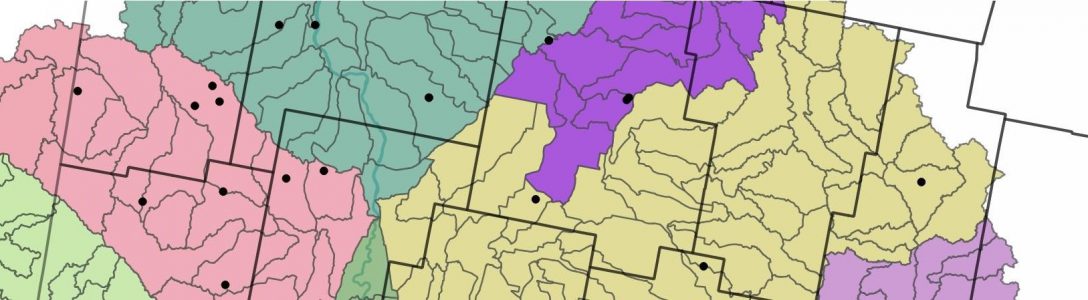
Are you as obsessed with ColorBrewer as I am? I am making a map where I color Ohio counties based on region, and used ColorBrewer to pick colors. The first thing I did was go to ColorBrewer and find a qualitative color set for 5 categories of data. Next I used the HEX codes provided… Continue reading Getting Category Colors into QGIS from ColorBrewer
Wind Barbs and Hourly Weather Forecasts
Are you an hourly weather graph enthusiast like me? I'm not convinced it actually makes me more prepared, but I love to know the precise forecast at the time of my commutes or planned bike rides. Usually I get my forecast from the National Weather Service. After putting in your zip code or City/State, you… Continue reading Wind Barbs and Hourly Weather Forecasts
Defining Common Terrain Derivatives
Last month I shared some ways to calculate terrain derivatives in SAGA, focusing on the Basic Terrain Analysis function. Today I'm going to give you a quick overview of what each derivative means and some of its potential uses. Let's start with the most intuitive ones. Slope is how fast elevation is changing. A higher… Continue reading Defining Common Terrain Derivatives
Navigation Pane
Two quick things I forgot to add last week when I wrote about tables of contents (catch up on the previous post here). First, you can use the "Heading 2" or "Heading 3" buttons to make subheadings. Subheadings can have different text formatting from the main headings and can be indented on the table of… Continue reading Navigation Pane
Table of Contents
More writing about writing! I expanded the example word document from the examples on adding captions to figures and line numbers. Now it has two different headings-- I'm going to format the headings and make a table of contents. To format the headings, I'm going to highlight the text and select the "Heading 1" option… Continue reading Table of Contents
Tips for Table Formatting: Rotating Data in Excel and Pages in Word
I'm working through the last chapter of my thesis this week and ran into some little challenges with table formatting. Originally I had site-year as my rows and soil property as my columns for a particular table, but I decided rotating the table 90 degrees made sense. I didn't want to have to move data… Continue reading Tips for Table Formatting: Rotating Data in Excel and Pages in Word
Data Collection Tools Revisited
Taking a break from the SAGA tips and writing about writing to remind you that planting season is fast approaching. While we're all going stir crazy in our offices, take some time to review some data collection tools that may make spring sampling easier on you and your team. I started with some Esri tools,… Continue reading Data Collection Tools Revisited
Line Numbers
Another little Word tip! When I collaborate on a document, I like to have line numbers in the margin. Then I can call people and ask them, "What do you think about page 5 line 15?" instead of, "What do you think about the 3rd sentence of the 2nd paragraph on page 5?" Is it… Continue reading Line Numbers
Basic Terrain Analysis: SAGA
If you missed my posts on terrain derivatives or SAGA, you may want to jump back and read those first. Today I'm going to talk about two very common terrain derivatives and how to calculate them in SAGA. I'm going to keep going with the same DEM from Mt. Gilead State Park I used in… Continue reading Basic Terrain Analysis: SAGA
Averaging Plot Data in R
In agronomy research, its very common to collect 10 plants from a single plot, take measurements on them, and average those measurements. The plot average is the value we run statistics on, whether that means building a regression or running an ANOVA. I've recently seen a lot of my fellow grad students averaging measurements by… Continue reading Averaging Plot Data in R
 Spatially Challenged