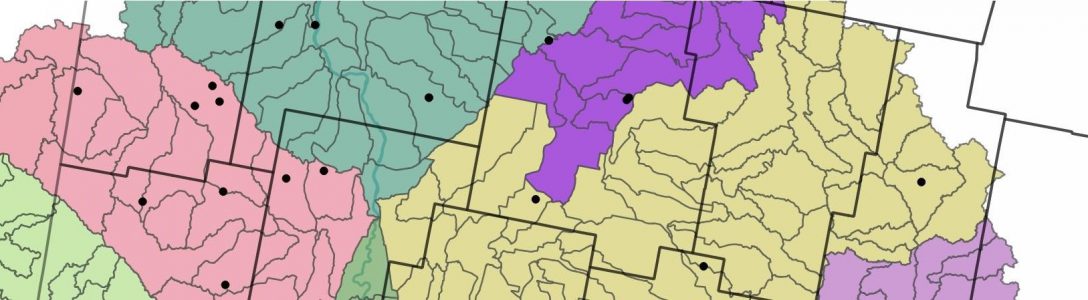
Satellite images have a wide variety of uses. They make a great backdrop for other maps and can give you an idea of land use in your area. The greenness in summer images can give you an idea of relative productivity. Bare ground photos taken when the ground is near field capacity can give you… Continue reading Data Sources for Satellite Images
Raster Data
If you work with spatial data, you'll likely come across rasters at some point. Raster data can be thought of as a grid of cells, and each cell contains a value. This value can be continuous, such as in an elevation model where the value in each cell represents feet above sea level. The Crop… Continue reading Raster Data
Random Forest
Machine learning algorithms are cool because the can handle continuous and categorical variables and have few assumptions about data distribution. As the name machine learning would imply, it's a highly automated process. Sometimes they take a while to compute, but the computer can be unsupervised during that time. One machine learning algorithm I use in… Continue reading Random Forest
New FAQ page!
I added a frequently asked questions page to the main menu-- if you're looking for class recommendations or a list of software to consider, check it out!
GIS Workshop in Columbus, OH
Byrd Polar Research Center and University Libraries are offering another basic GIS course. I heard great things about last year's workshop and wanted to share this opportunity with you. This year's focuses on Google and Esri based tools. Students are encouraged to bring laptops and mobile devices to get some hands-on experience. If you're in… Continue reading GIS Workshop in Columbus, OH
Basic Statistics Fact Sheet
This might be an older fact sheet (originally published in 2008), but it's still an incredibly helpful guide: Highlighted Fact Sheet I like it for a few reasons. Firstly, it's written in plain English. There's not a single equation in it, and the whole paper is only 3 pages. Secondly, and probably more importantly, it… Continue reading Basic Statistics Fact Sheet
How far apart are half acre grid soil samples?
I take a lot of soil samples on a half acre grid. Since linear measurements are easier to visualize, a lot of people ask me how far apart those samples are. This is also helpful if you're trying to make your own sampling map. An acre equals 43560 square feet. If you want to take… Continue reading How far apart are half acre grid soil samples?
Help me find this place again: how to drop, save, and send pins in Google Maps
Let's say you are scouting a field and notice a tile blowout. You need to communicate the location of this problem to your employer, the field owner, or an employee. While you could say something along the line of "go to Field X at the NE corner of County Road Y and Section Line Road… Continue reading Help me find this place again: how to drop, save, and send pins in Google Maps
What is GIS?
People ask me what I'm up to, and frequently my answer is "oh, just working on some data cleaning in GIS." This usually leads to the follow up question, "What is GIS?" Turns out that's kinda hard to answer. GIS stands for Geographic Information System. Note the word geographic-- the information involved has coordinates or… Continue reading What is GIS?
Welcome to Spatially Challenged!
I get lots of questions about how I collect samples, analyze data, and make maps. In this blog I plan on highlighting tools I love, emphasizing free and open source resources. I'll also share some mistakes I've made and tips for how to avoid them-- learn from my mistakes! This is a pretty busy time… Continue reading Welcome to Spatially Challenged!
 Spatially Challenged